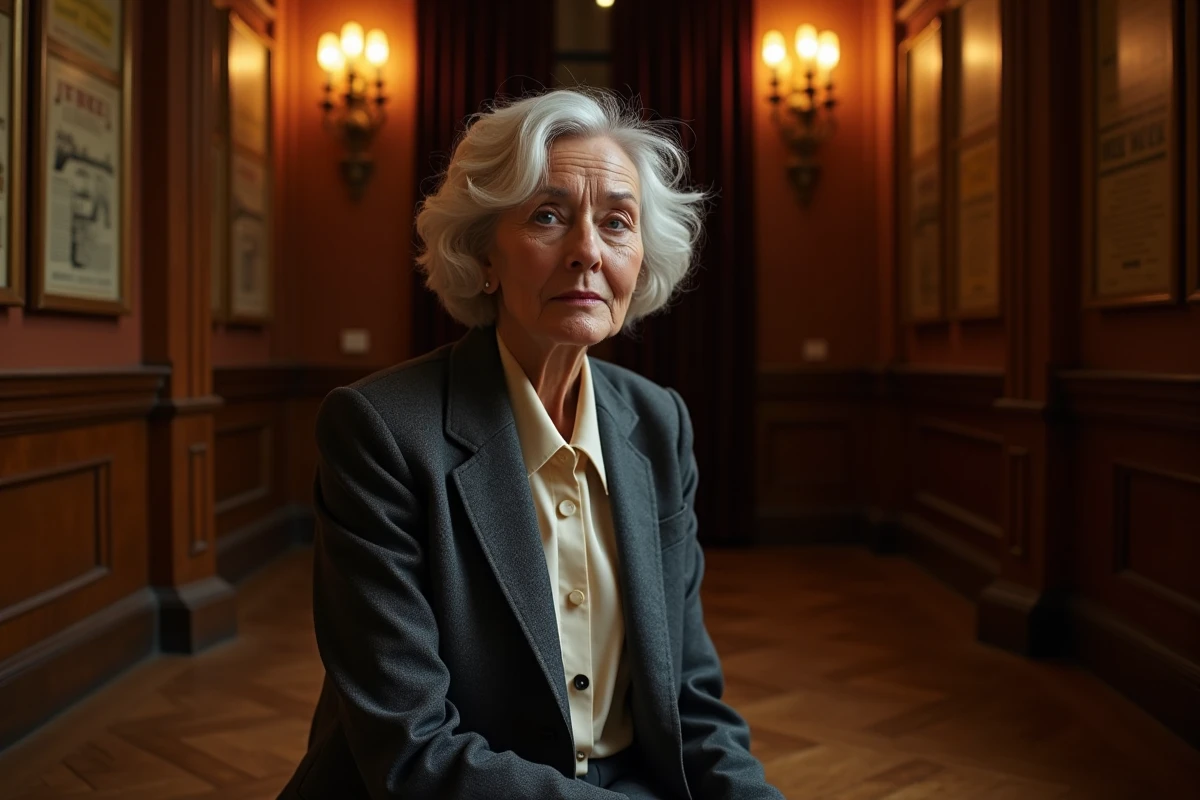
Marie-Christine Barrault, born on March 21, 1944, in the 8th arrondissement of Paris, is a French actress whose career spans over five decades across film, theater, and television. Niece of Jean-Louis Barrault, she trained at the Cours Simon and then at the Conservatoire before making her debut on the boards of the Théâtre de France, under her uncle’s direction.
Her journey reflects a constant: the search for roles where speech, text, and voice occupy a central place. From My Night at Maud’s by Éric Rohmer to the public readings she gives today at literary festivals, this actress remains attached to a physical relationship with language.
Éric Rohmer and the Revelation in My Night at Maud’s
Before filming My Night at Maud’s, Marie-Christine Barrault had only made a few appearances on television and had minor roles in film. She plays a young Catholic woman opposite Jean-Louis Trintignant and Françoise Fabian, in a story constructed almost entirely around dialogue.
This role highlights a quality that will become her signature: a discreet presence yet physically grounded in the scene. Rohmer did not direct his actors in a conventional way. He placed them in situations and let them inhabit the frame.
Marie-Christine Barrault finds a playing style where silence weighs as much as the word. To better understand her complete journey, the biography of Marie-Christine Barrault retraces the significant stages of her training and artistic choices.
Recent academic research has also focused on this vocal work in Rohmer’s films. A study published in the journal Miranda by Sabrina Parent analyzes the voices of desire in the filmmaker’s work, highlighting how Rohmerian actresses construct their characters through intonation and speech rhythm rather than physical action.
Cousin, Cousine and the Oscar Nomination: International Career
The film Cousin, Cousine by Jean-Charles Tacchella, released in 1975, propels Marie-Christine Barrault to a much wider audience. The romantic comedy enjoys commercial success in France, but especially in the United States, where it receives an Oscar nomination for Best Actress.
This nomination opens the doors to international cinema. Woody Allen gives her a role in Stardust Memories. Andrzej Wajda directs her in A Love in Germany. Volker Schlöndorff gives her a place in Swann’s Way.
- Woody Allen, Stardust Memories: a role that exploits her simultaneously bright and restrained range, opposite a filmmaker accustomed to American actresses
- Andrzej Wajda, A Love in Germany: a film that distances her from comedy to anchor her in a historical drama
- Volker Schlöndorff, Swann’s Way: an adaptation of Proust where the question of text and voice comes to the forefront
The 4K restoration of Cousin, Cousine and its rebroadcast in several English-speaking film archives starting in 2023 have rekindled critical interest in her performance. Articles in American and British specialized press now describe her interpretation as pioneering a female naturalism in French cinema of the 1970s.
Theater and TV Films: An Actress of the French Stage
Theater has never been a side project for Marie-Christine Barrault. Trained on stage, she regularly returns to it throughout her career. Her work in theater reflects the same choices as her film career: dense texts, often literary, carried by voice.
On the television side, she accumulates roles in French TV films. This format offers her the freedom to portray complex female characters, often mothers or maternal figures, without falling into stereotypes. The TV film provides her with roles that auteur cinema does not always offer: women grounded in social realities, confronted with concrete family dilemmas.
Public Readings and Commitment in Hospital Settings
In recent years, Marie-Christine Barrault has dedicated a significant part of her activity to public reading. She regularly participates in the network of literary festivals in the region, notably the Culturissimo festival (supported by the Cultura Foundation) and the Nuits de la lecture, where she reads both classics and contemporary texts.
This work logically extends her training and practice. Reading aloud in front of an audience requires the same skills as performing on stage: breath control, sense of rhythm, ability to inhabit a text without overacting.
An even less documented aspect of her career concerns her interventions in hospital settings and palliative care. She offers readings aloud for patients and their families. This practice, at the intersection of art and care, remains little visible in media portrayals, even though it mobilizes an actress’s expertise applied in a radically different context from the stage.
- Readings at regional literary festivals (Culturissimo, Nuits de la lecture, media libraries)
- Interventions with patients in palliative care, documented by associative reports
- Choice of varied texts, from the classical repertoire to contemporary literature
Marie-Christine Barrault, at over 80 years old, continues to work. Her journey cannot be summed up by a filmography: the voice remains the common thread of her entire career, from Rohmer’s stage to hospital rooms. The text read, performed, physically embodied, constitutes the raw material of a profession she has never ceased to practice.