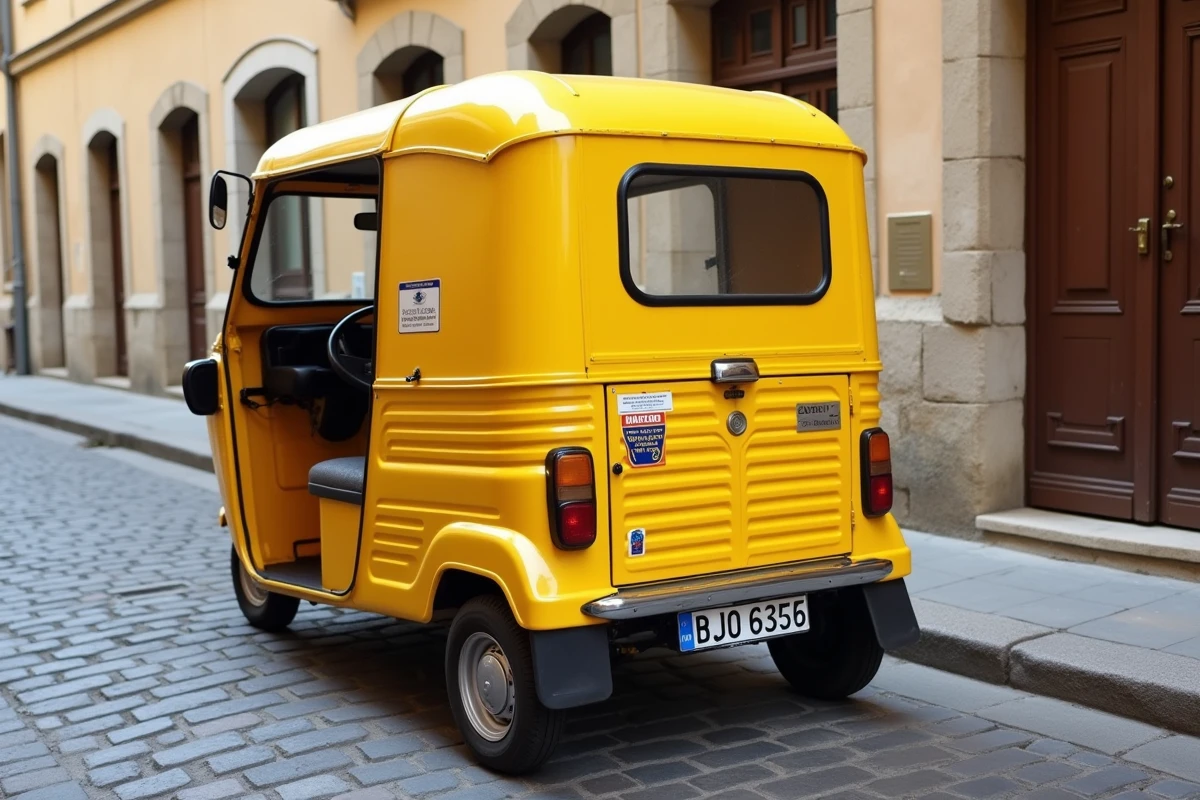
A tour operator in Marseille orders an electric tuk-tuk from an importer, with a budget of a few thousand euros. Upon receiving the final quote, the invoice has nearly doubled: L5e approval, compliance with European standards, registration fees. This scenario has been repeating regularly since the DREAL and UTAC tightened controls on imported three-wheeled vehicles.
L5e Approval in France: The Constraint That Sets the Real Price
The price displayed by an Asian manufacturer or an online reseller never reflects the final budget for legally driving in France. The single vehicle reception (RTI) required by European regulations mandates compliance tests on the protective structure, braking, and emissions. Since the end of 2024, the CNPA has reported an increase in refusals for individual approvals for thermal tuk-tuks lacking ABS or an adapted structure.
In practical terms, a non-compliant tuk-tuk upon arrival in France becomes unsellable. The costs of bringing it up to standard (modifying the chassis, adding a braking system, passing through UTAC) can represent a significant portion of the initial purchase price. Before comparing catalog prices, it is essential to check if the model already has L5e or L2e European approval, which radically changes the financial equation.
For those considering the purchase of an approved tuk-tuk in France, the difference between a pre-approved vehicle and a model needing regularization amounts to thousands of euros and several months of administrative delay.

Electric or Thermal Tuk-tuk: Price Gap and Access to Low Emission Zones
The choice between electric and thermal engines is not just an ecological preference. Since 2024, several metropolitan areas (Paris, Lyon, Grenoble, Montpellier) grant electric tuk-tuks of category L5e the same traffic advantages as electric quadricycles: access to low emission zones and easier parking.
In professional use, the electric model offsets its initial higher cost through profitability in low emission zones. A thermal tuk-tuk banned from circulating in the center of Lyon or Paris loses most of its commercial appeal. Approved electric models are more expensive to purchase, but their daily operation in the city remains viable from a regulatory standpoint.
Real-World Range and Charging
User feedback varies on this point depending on the users and routes. In urban environments with frequent stops, the range advertised by manufacturers drops significantly. It is recommended to test the vehicle on a representative circuit before signing, rather than relying on catalog data.
The cost of charging remains modest compared to fuel, but one must plan for the installation of a suitable outlet if the vehicle is parked in a professional location. This expense is often overlooked in initial estimates.
Insurance for a Tuk-tuk in France: Common Surcharges and Refusals
Insurance is a budget item that many future owners underestimate. In 2025, some insurers specializing in VTC and chauffeur-driven vehicles, notably AXA Climate through its “new mobility” offers, refuse to insure thermal tuk-tuks imported outside the manufacturer’s network. Other regional brokers apply surcharges that can reach discouraging levels.
This situation effectively restricts the used market. A thermal tuk-tuk imported without an official distribution channel in France, even if properly approved, poses an insurability issue. Before purchasing, it is advisable to contact at least three insurers to obtain firm quotes.
- Check that the model is listed in the insurers’ databases (mines code or equivalent L5e)
- Request a written quote before signing the sale, not after
- Prefer brokers who have already covered tricycles or vehicles of category L
- Compare deductibles and exclusions, not just the annual premium

Total Budget for an Approved Tuk-tuk: Items Not to Forget
The catalog price is just the first line of the budget. Here are the items that are consistently found when purchasing in France, whether it is a new or used vehicle.
- Approval and registration: UTAC or DREAL processing, regional tax, processing fees. A vehicle already registered in France simplifies this step
- Transport and logistics: delivery from the port or the importer’s warehouse, often charged as an extra
- Compliance: possible adaptation of the braking system, lighting, mirrors in accordance with European regulations
- Annual insurance: varies depending on the driver’s profile, usage (private or professional), and type of engine
- Maintenance and spare parts: the availability of parts in France conditions the long-term cost. A model distributed by a local network facilitates repairs
New or Used: What Really Changes
A used tuk-tuk already registered with a French registration document eliminates the approval item, often the most expensive and time-consuming. Ads can be found on generalist platforms, but the price range varies significantly depending on mechanical condition, year, and administrative compliance.
In contrast, a new model ordered from an importer offers a warranty and follow-up, but the time between ordering and putting it into circulation can extend over several months, while waiting to complete the approval.
The choice between new and used primarily depends on the service start date. A professional who needs to start a tourist activity for the summer season does not have the luxury of waiting for an RTI. A passionate individual can afford a longer process to obtain exactly the desired model.
The French tuk-tuk market remains a niche market where each purchase resembles more of a project than a simple transaction. Anticipating approval costs, securing insurance, and checking parts availability before signing remains the safest method to avoid financial surprises.