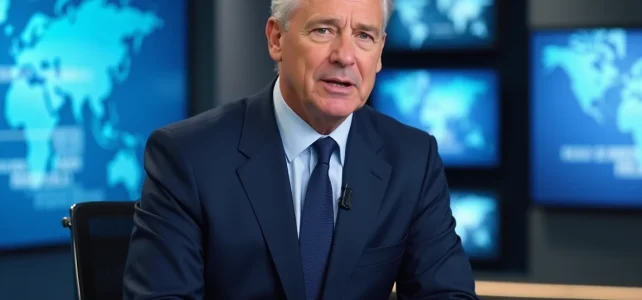
A military consultant coughs, puts his hand to his chest, and loses the thread of his sentence. The presenter hesitates for a second, and the control room cuts the wide shot. This type of scene, rare but striking, poses a concrete problem for 24-hour news channels: what to do when a guest shows signs of distress live on air?
On-air protocols in case of distress: what channels have changed since 2022

Since 2022-2023, several channels have formalized what are called on-air protocols for live health incidents. The principle is simple: as soon as a guest shows signs of physical distress, the control room cuts the video feed or switches to another shot.
Recommended read : How to Install MS PowerPoint for Free on Your PC: Complete Guide and Tips
These protocols outline three nearly simultaneous actions. The floor manager gives the order to cut. The presenter delivers a brief explanatory message to the audience. And the images of the distress are not rebroadcast.
France Télévisions updated its “emergency on-air rules” in 2022, following incidents involving guests or commentators experiencing distress on set. TF1 followed a similar approach in its internal codes of conduct. These revisions have been commented on by journalist unions and documented in the annual reports of journalism organizations. To delve deeper into the specific case that reignited the debate, an article details the illness of Pierre Servent on Cydlab and the reactions of the involved newsrooms.
Further reading : How to Follow Up by Email?
You may have noticed that after such an incident, channels often broadcast a simple banner saying “our guest has been taken care of”? This is precisely one of the key phrases outlined by these protocols.
French legal framework: protection of vulnerable individuals on air
These protocols are not just a matter of good will from newsrooms. French law regulates the broadcasting of images of individuals in vulnerable situations, including on a television set.
Arcom (formerly CSA) can sanction a channel that exploits images of a live distress incident for sensationalist purposes. Regulation has tightened in recent years regarding the protection of vulnerable individuals on air, which limits how channels can show or comment on an expert’s illness live.
In practical terms, this means that a channel that rebroadcasts the sequence of a consultant experiencing distress repeatedly would expose itself to sanctions. The right to one’s image and respect for dignity take precedence over the logic of “buzz”.
Training presenters in managing medical crises live
Cutting a camera is a technical gesture. Managing the moment humanely in front of hundreds of thousands of viewers is a much more delicate exercise.
Since 2021, organizations like INA training and journalism schools (CFJ, EJT) have added training sessions on managing live situations in crisis to their catalogs. These modules detail the reflexes to adopt when a guest experiences distress:
- Immediate cut of the shot on the guest and switch to a neutral visual or a control room screen
- Verbal relay by the presenter with a calibrated message, neither dramatizing nor minimizing
- Coordination with emergency services (calling SAMU from the control room) while the broadcast continues on another topic
- Systematic debriefing after the incident to assess the team’s reaction
These trainings emphasize a point often overlooked: the presenter should never attempt to diagnose live. Saying “he seems to be having a stroke” or “it’s probably a cardiac distress” is medical speculation and can cause unnecessary panic, even harming the individual concerned.
The pivotal role of the floor manager
In the decision-making chain, the floor manager plays a more decisive role than the presenter himself. It is he who, from the control room, orders the change of shot, launches a substitute topic, and coordinates the possible arrival of emergency services on set.
The speed of his reaction determines whether the incident remains a moment handled with dignity or becomes a viral clip shared out of context on social media.
Non-rebroadcasting of images and post-incident management on social media
The question does not stop at the end of the live broadcast. Recent protocols include a clause for non-rebroadcasting of images of the distress. Replays are edited to remove the sequence, and excerpts are not posted online on the channel’s official accounts.
This precaution has an obvious limit: viewers sometimes film their screens and share the sequence on social media. The channel does not control this secondary distribution, but it can at least avoid feeding it itself.
Post-incident management also includes a communication aspect. Newsrooms generally publish a sober statement, providing updates on the individual concerned if they consent. The tone is factual, without pathos.
When distress becomes a media topic in itself
Sometimes, the health status of the expert becomes a news topic in itself, especially when it involves a well-known public figure. Channels then find themselves in a paradoxical position: dealing with information that directly concerns them.
In this case, the line of conduct is to separate factual information (confirmed hospitalization, family statement) from commentary. Newsrooms avoid speculating on the diagnosis and refer to official medical sources.
The media treatment of an expert’s illness live reveals the ongoing tension between two logics. On one side, the pressure of continuous flow that pushes to show, comment, and revisit the event. On the other, a regulatory and ethical framework that imposes restraint. The protocols implemented in recent years show that news channels have learned concrete lessons from these situations, even if total control of the image remains illusory in the age of social media.